Ilmara.net
Evolution Theory
Truly, the false Messiah will be preceded by years of deception,
in which the truthful will be lied to, the liars will be believed,
the trustworthy will be discredited,
the traitors will be trusted, and the shameful will speak.
(Musnad Ahmad)
Through its propaganda machine, which likes to use so-called science, the dajjalic-system manages to dissuade many believers from their faith, or at least to follow its agenda (‘Follow the science’). This kind of so-called science aims primarily at one thing: removing God from the equation and portraying religion as something backward and naive – something for idiots who have no knowledge.
One of the main arguments against a creator god, it is postulated, would be the theory of evolution, which is supposed to prove that humans were not created and did not descend from Adam and Eve, but rather had common ancestors with apes and evolved from them in a process called evolution.
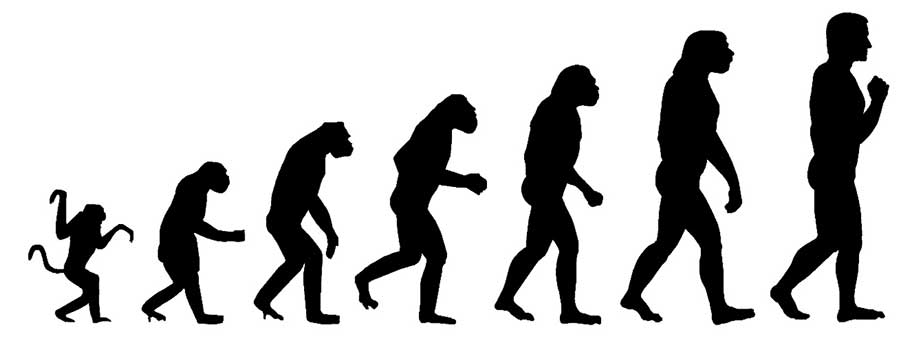
Images such as the one above seem to be very convincing to many people, mainly because they are reproduced thousands of times and appear to be backed by serious science. However, it is important to remember how serious science actually works:
- One asks a question. In this case, where do humans / living beings come from?
- One makes observations and collects data.
- One formulates a hypothesis.
- One conducts an experiment to prove the hypothesis and repeats it often enough.
- The results are analysed again and the theory is formulated.
In the theory of evolution, it is easy to see that the strictly scientific method was not applied at all!
The theory of evolution rests on two pillars: a) genetic modification, i.e. mutation through influences such as radiation or chemical reactions, and b) selection. Both then lead to adaptation: the organism that best adapts to the environment through its changing genes prevails and can reproduce, while the others die out (‘survival of the fittest’).
Selection can, of course, be observed and is relatively easy to prove in an experiment. The entire theory of breeding falls under this category. But breeding has never created a new species. Selection alone is not enough to explain evolution. What about the random mutation of genes, which is supposed to create new useful characteristics such as wings, noses and legs?
In fact, no cell mutation has ever been observed that produced positive characteristics or increased the information content! When cells are exposed to radioactive radiation and mutate, for example, this has exclusively negative effects and generally results in illness and death for the individual. Two essential pillars of serious science were simply omitted: observation and repeated experiments. The hypothesis was simply retained and presented as a virtually proven theory.
Of course, there is evolution among living beings! Even if one believes that all humans are descended from Adam, different human races have evolved. But this evolution is not due to random mutations in genetic material, but to the will of Allah, who creates whatever He wants. And this can be proven, among other things, by the following:
Intelligent Design
If we found a clay tablet with writing on it somewhere, would we assume that it came about by chance? We might not be able to decipher the characters, but we could be sure that it came from intelligent beings. This is because a coding system is always the result of a mental process. It requires an intelligent source or inventor. Matter itself is not capable of creating a code. All experience teaches us that an intelligent being is required. There are no known laws of nature, no processes and no series of events that can independently produce coded information in matter.
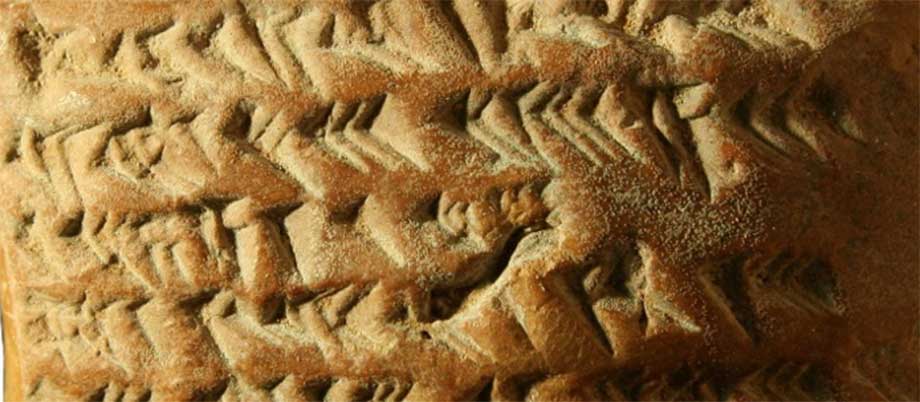
The base pairs of DNA are a code, a highly intelligent one that can produce extremely complex structures. Adenine, thymine, guanine and cytosine are the basic building blocks, like the dots, dashes and spaces in Morse code. These three elements form 26 letters, which in turn can be used to form hundreds of thousands of words. The four elements (nucleotides) of the base pairs form 20 amino acids, which in turn form approximately 100,000 proteins. DNA is therefore the language of life! And this must originate from an intelligent source, because coded information always comes from an intelligent source.
What Charles Darwin did not address in his theory of evolution was where the first cell actually came from. Even the simplest cells are highly complex structures that simply cannot arise by chance. Scientists estimate the probability of finding a functional protein among the countless combinations of amino acids to be 1 in 10 to the power of 164! An incredibly small probability! By way of comparison, there are only 10 to the power of 80 elementary particles in the universe, and the time from the Big Bang to today lasted only 10 to the power of 16 seconds.
Louis Pasteur said in this context: ‘Can matter organise itself? No! To date, there are no known conditions under which it could be confirmed that microscopic organisms came into this world without parents that resemble them.’
Archeology
Most people believe that archaeology confirms the theory of evolution. The exact opposite is true! First of all, we should mention the explosive emergence of countless new species in the Cambrian period. According to the theory of evolution, species should develop like a tree from the trunk to the branches and twigs, i.e. starting with a few species that slowly branch out and multiply. But in the Cambrian period, it was exactly the opposite. At the beginning of the Cambrian period, there were suddenly many new species, with no evidence that they had common ancestors – and at the end, there were far fewer.
Charles Darwin himself said: ‘If numerous species, belonging to the same genus or family, had all come into existence at the same time, this fact would be fatal to the theory of descent with slow modification through natural selection.’
Palaeontology clearly shows that the various species appeared spontaneously and without connection to other species. If such connections existed, they would have to be extremely numerous and clearly document the transition from one species to another, but only a few meagre examples of alleged connections between species are shown, such as Seymuria, Echidna, Archaeopteryx or Homo habilis. Not nearly enough to scientifically document an evolutionary transition from species to species, but enough to deceive the unsuspecting public, which has been inundated with imaginary images of prehistoric humans.
There have been approximately 6,500 species of apes throughout Earth's history. Their remains provided ample material for the imagination of evolutionists, who arranged and modelled the skulls of apes from small to large and gave them skin and hair – and voilà: here we have primitive humans and the transition from ape to human! Except that you can't deduce skin and hair from a skull! In the case of Nebraska Man, the entire prehistoric human was reconstructed based on a single tooth, which later turned out to have come from a wild boar!
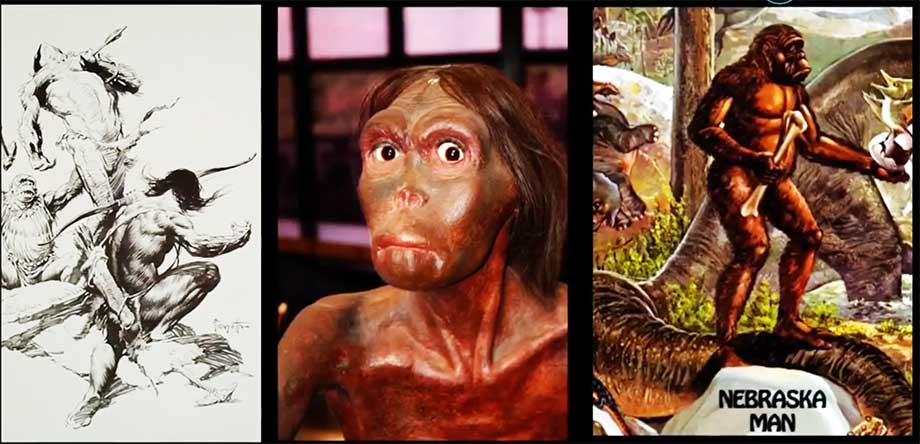
Many other so-called primitive people were also quickly consigned to the dustbin of history, such as:
- Neanderthals, ‘discovered’ in 1856 – discarded in 1960
- Piltdown-Man 1912 "discovered" - discarded in 1953
- Zinjantrophus 1959 "discovered" - discarded in 1960
- Ramapithecus 1964 "discovered" - discarded in 1973
Even Australopithecus, commonly known as Lucy, who is said to have been the first human, turned out on closer inspection to be nothing more than an extinct ape that differed little from today's chimpanzees. After examining the bones, leading experts in anatomy vehemently disputed that Australopithecus walked upright.
Other so-called intermediate stages, which are supposed to demonstrate the development from ape to human, such as Homo erectus, Homo ergaster or Homo sapiens archaic, are, on closer inspection, nothing more than earlier human races that do not differ any more from today's human races than today's human races differ from each other. Nevertheless, many of the above ‘prehistoric humans’ are still presented to the public as precursors of humanity, as if these were established scientific facts.
Just try to imagine, for example, how front legs could turn into wings. It would require a long series of virtually impossible coincidences stretching over millions of years. During this time, these intermediate creatures would have neither proper legs for walking nor wings capable of flight. They would therefore have been wiped out by selection long before this process was complete! Here, and in countless other examples, selection would not be the driver of evolution, but would most certainly prevent it.
For example, if a fish wanted to develop legs in order to transform itself into a reptile, how many mutations would be necessary? Some kind of stumps would have to slowly form from the sides, symmetrically of course. How long would it take for these stumps to become functional legs? During this entire long period, however, they would be anything but streamlined, and any predator would not only be amused by these mutants, but would also eat them.
Such long processes should be abundantly documented archaeologically and still observable today. Even today, there should be plenty of creatures running around with useless mutations, hoping that these will prove useful at some point. The fact that such processes cannot be documented or observed leads to only one conclusion: a long series of impossible coincidences is not responsible here. God changes the code of life, and changes occur abruptly.
Beauty
To any thoughtful person who observes it closely, nature appears to be something profoundly wonderful and, as a rule, beautiful. When we look at our own creations, however – technology, machines, noise and pollution – it becomes clear that what is useful is by no means necessarily beautiful.
If utility alone were the decisive criterion for the evolutionary advantage of a being, then the world of living creatures would have to be far less beautiful on average than it actually is. Blind coincidences that merely produce useful characteristics could hardly create such an abundance of beauty and harmony.
Rather, the order and aesthetics of nature reveal the handiwork of the Creator, who brings forth creatures through the code of life and gives us an impression of His power and wisdom through them.
In the creation of the heavens and the earth
and in the difference of night and day
aare tokens for men of understanding.
Such as remember Allah, standing, sitting, and reclining,
and consider the creation of the heavens and the earth:
Our Lord! Thou createdst not this in vain.
Glory be to Thee! Preserve us from the doom of Fire.
(Ali Imran 190, 191)
Impossible coincidences
The Qur'an provides a simple but entirely sufficient argument:
Or were they created from nothing,
or are they themselves the creators?
Or did they create the heavens and the earth?
No! Rather, they are not convinced.
(at-Tur 35-36)
By telling us to ask ourselves simple questions, Allah points us to the clear answer. The questions in the verse above are as follows:
1. Can creation come from nothing?
2. Can creation create itself?
The answer to both questions is no. Clearly, nothing can come from nothing. Nothing comes from nothing, as the saying goes. Nor, of course, could creation have pulled itself out of nothing. So there must be an external cause, and since neither space nor time existed before the Big Bang, this cause must be transcendent and without beginning or end, with precisely the attributes ascribed to God!
In addition to the arguments listed above, namely that information cannot arise spontaneously from matter without an intelligent creator, or that the probability of finding a functional protein among the almost infinite number of possible combinations of amino acids is virtually zero, there are further arguments like for example the cosmological constant. Nobel Prize winner Steven Weinberg said:
It seems as if incredible fine-tuning is constantly necessary. The existence of every form of life seems to require a cancellation of various contributions to vacuum energy, which should be accurate to approximately 120 decimal places. If not, the universe would go through a complete cycle of expansion and contraction before life could arise, or it would expand so rapidly that the formation of galaxies and stars would not be possible. (Life in the Universe, Scientific American, October 1994, p.49)
The probability that this fine adjustment occurs purely by chance is virtually zero. Put all the grains of sand on Earth into a huge container and paint one of them red. Then blindfold someone and tell them to take a single grain of sand from this immense container. The probability of them randomly picking out the red grain from among all the grains of sand in the world is just as small. It is virtually impossible!
The cosmological constant is just one more example among many others, such as the ratio between electrons and protons, the ratio between electromagnetic force and gravitational force, the mass density of the universe, and so on and so forth.
Quantum physics
In the mid-1960s, physicists John Wheeler and Bryce DeWitt successfully combined the previously incompatible ideas of quantum mechanics and general relativity in a key result that has since become known as the Wheeler-DeWitt equation. The problem, however, was that time played no role in the equation. The equation actually states that nothing ever happens in the universe – a statement that clearly contradicts what we observe every day. Then, in 1983, theorists Don Page and William Wootters came up with a solution based on the quantum phenomenon of entanglement. They showed that time is an emergent phenomenon arising from the nature of entanglement – and it only exists for observers within the universe. A god-like observer sees only a static, unchanging universe, as predicted by the Wheeler-DeWitt equation. Of course, without experimental evidence, Page and Wootters' ideas were little more than a philosophical curiosity. And since it is never possible to have an observer outside the universe, it seemed that there was little chance of proving the ideas. Now, however, Ekaterina Moreva of the Istituto Nazionale di Ricerca Metrologica in Turin, together with a few colleagues, has conducted the first experimental tests of Page and Wootters' ideas. And they confirmed that time is indeed an emergent phenomenon for ‘internal observers’ but does not exist for ‘external’ ones.
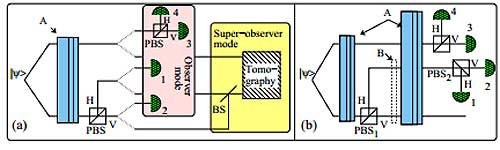
"Although extremely simple, our model captures
the two seemingly contradictory properties
of the Page-Wootters mechanism,
say Moreva and colleagues.
For evolutionary theory, this means that there is no such thing as chance, because when we view the universe from a godlike perspective, everything is already predetermined. Even if we do not believe in God and assume, against all reason, that the universe pulled itself out of nothingness by its own hair, like Münchhausen from the swamp, the future already existed when space-time came into being. The universe is a unity of creation and everything is predetermined (or already written), just as the Koran claims.
Know you not that Allah knows all
that is in the heaven and on the earth?
Verily, it is (all) in the Book (Al-Lawh Al-Mahfuz).
Verily, that is easy for Allah.
(al-Hajj 70)
How can people seriously believe that creation came about by chance, with all these facts and, above all, with the entire wonderful creation before their very own eyes? This can only be explained by the fact that they have been subjected to brainwashing by the Dajjal since childhood. This proves the saying: ‘If a lie is repeated a hundred times, it becomes the truth!’ So in reality, it's not ‘follow science’ but ‘follow the money!’ People with power and money determine the narrative.
____________________
Related Articles:
 |
Seeking Hidaya Guidance is a central theme of the Qur'ân, it is mentioned far more than a hundred times therein! It is itself called "the guidance for the god-fearing" and "the criterion (of right and wrong)"! Unfortunately, Qur'ân and Sunnah are nowadays mostly reduced to its function as the "lawgiver" only, not so much seen as a spiritual guide... |
 |
A picture in the mirror The power of the rational mind is impressively demonstrated to us every day, because all modern technology is based on it. The fact that technical progress is linked with the destruction of the planet is, however, not blamed on rationality... |