Ilmara.net
Seeking Hidaya
Show us the straight path,
The Path of those you have favoured.
Guidance is a central theme of the Qur'ân, it is mentioned far more than a hundred times therein. It is itself called "the guidance for the god-fearing" and "the criterion (of right and wrong)". Unfortunately, Qur'ân and Sunnah are nowadays mostly reduced to its function as the "lawgiver" only, not so much seen as a spiritual guide.
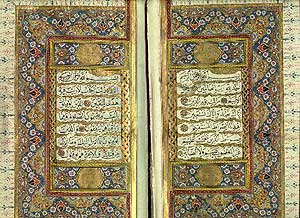
We pray every day numerous times for guidance, however, do we realize, how this guidance comes to us? Ask yourself: When you ask Allah for guidance, how do you expect Him to guide you? I think most people never gave much thought about it. Therefore let us try to become aware of this matter because it is of the utmost importance for us. Let us first take a look at the different types of God's guidance.
Wahy
This kind of guidance is reserved for the Prophets (but is also used in the Qur'an in connection with bees, earth, heaven and angels), normally in the sense of "inspiration" or "revelation". The nature of this kind of guidance is different from that of the average believer in its form and function. As the Prophets are closer to God, the guidance is as well; to Musa a.s. Allah spoke even directly. And, the revelations are normally for the public whereas the guidance for the normal believer is not.
And it was not [vouchsafed] to any mortal that Allah should speak to him unless [it be] by revelation or from behind a veil, or [that] He sendeth a messenger to reveal what He will by His leave. Lo! He is Exalted, Wise. (As-Shura 51)
But although the quality of the guidance of them was different from the average believer, they still serve as example for us in different aspects: Their trust in God! Their surrender to His will! Their recognition of being a servant of Allah! Being afraid of Allah only and nobody else, knowing that all power is in His hands and so on. They make us understand what we need to develop in order to be able to receive guidance.
Indeed, in their stories is a lesson for those of understanding. This is no forged tale, rather, it is a confirmation of the previous, a distinguishing of all things, a guidance and a mercy to a nation who believe. (Yusuf 111)
Every prophet had his own special mission. Prophet Musa a.s. (Moses), for example, was sent to confront Pharaoh and lead the Israelites out of Egypt and reveal their law to them. In fact, every human being has his own task, which is of course not as important as that of a prophet, but is nevertheless important to recognise. The Prophet (peace be upon him) told us that the Ummah is like a body, and when one part of the body is sick, the whole body reacts with fever. Every Muslim is therefore a part of this body, and just as every part of the body has its specific function, so too does every Muslim according to his God-given abilities. As a rule, it is easy for us to do what we were created to do, just as it is easy for a hand to grasp but difficult to run.
The first step in finding out what our task actually is is to believe in a task in the first place and to ask about it. One should not constantly ask God for what one wants or desires, but rather ask God what He wants from us. When we remember that we are God's servants and find our task, we will see that it comes easily to us, because God created us precisely for this task. We do not need to worry about our reward, because God is the best employer and rewards His servants with far more than they could ever hope for or even dream of.
Allah has promised forgiveness and a great reward to those of them who believe and do righteous deeds. [Al-Fath 29]
Il-Ham
Intuition is a form of guidance which can be received by ordinary man. This intuition does not equal the divine inspiration (wahy) of the prophets in strenght or certainty, because of the possibility that what is apprehended by the friend of Allah (wali) is merely thoughts of his own mind. As it is sometimes admixed, and other things are mistaken for it, the possibility of error exists in it, and it cannot be a basis for establishing legal rulings or a criterion for works. Examples for this form of guidance are e.g. Abu Bakr r.a. who knew that his wife was pregnant with a boy and Umar r.a., who was aware of an ambush towards a Muslim army in Persia and called during a Friday sermon the name of the Amir of this army: "O Sariya, the mountain!"
Al-Furqan
The month of Ramadan is the month in which the Koran was sent down, a guidance for people, and clear verses of guidance and the criterion. (al-Baqarah 272)
Through Wahy the first source of guidance for mankind was revealed: Al-Qur'ân! Directly in the second Surah, after in the first Surah we ask for guidance, Allah let us know: "This is the Book (the Qur'ân), whereof there is no doubt, a guidance to those who are Al-Muttaqûn. "
But, there are some problems attached:
-
Most Muslims today are Non-Arabs and need a translation. A translation however is never equal with the original and distorts to a certain degree its meaning. Even Arabs do not always know the subtlety of the Qur'ânic Arabic.
-
The Qur'an needs interpretation! Although most things seem clear, we often need additional explanations (tafsir). Especially when a rule or law is to be established, a verse must be categorised and related to other verses and ahadith (reports about the Prophet). Since scholars often disagree among themselves, which interpretation should we follow? It seems that we need God's guidance again to understand the guidance of the Qur'an correctly.
-
It is not always possible to put the Sharia and Sunnah into practice in today's world. Who works in Europe will have difficulties explaining his employer that he needs to take a nap at noon because it is Sunna! Even things which are explicit haram appear sometimes not avoidable like the use of paper money. How do we decide what we want to implement from the Koran and Sunna in our individual situation and what consequences we are willing to accept for doing so?
Hadith
The next source of guidance for us is the reports from the Prophet s.a.w. The same problems we have with the Qur'ân we have also with the ahadith but even more: The ahadith are less reliable than al-Qur'ân and not immune against forgery and error.
Scholars
The schools of law in Islam are the most reliable source of jurisprudence we have. This type of jurisprudence serves primarily to determine the extent to which our actions comply with divine law. Furthermore, the doctrines (Aqidah) of Ash'ari and Maturidi are probably the most reasonable, as are the teachings of early Sufism, such as those of Imam Qushayri. All human made and therefore not perfect.
Mushwara
When seeking a decision on a particular issue, it is recommended to consult with knowledgeable confidants in order to better weigh the pros and cons of a matter and to see aspects that one might have overlooked or given too little importance to.
And those who listen to their Lord and perform the prayer, settle their affairs through consultation among themselves. [As-Shura 38]
Istikhara
If you have already sought advice, or if this is not possible, it is advisable to ask God directly for guidance with a special prayer called Shalat Istikhara.
Jabir (r) reports: The Messenger of Allah (s) taught us repeatedly to seek God's guidance in every matter, just as he repeatedly taught us a surah from the Qur'an. He said: "If any of you intends to do something, he should perform two rak'ahs and then say: 'O Allah! I ask You for Your advice based on Your knowledge; I ask You for strength based on Your strength, and I ask You to give me from Your immense goodness; for You alone have the power and I do not. You know everything and I know nothing. You alone know the unseen. O Allah! If You know that this matter is good for me, for my religion, my life on earth and my life in the Hereafter, then decree it for me and make it easy for me to achieve! Then bless this (what You have granted me). However, if You know that this matter is bad for me, for my religion, for my life on earth and for my life in the hereafter, then turn it away from me and keep me away from it! Decide what is good for me, wherever it may be, and make me content with it.‘ He said: ’And he should name his matter." [Al-Bukhari]
Hidaya
In order to correctly implement the Qur'an and Hadith in our individual lives and make the right personal decisions, we must ultimately trust our inspiration and intuition, the voice of the heart. We call this guidance of the heart Hidaya.
Allah mentions several conditions in the Qur'an for Him to guide us. Allah does not guide fasiqun (evildoers), dhalimun (oppressors) and kafirun (unbelievers). He does not guide unjust people or those who follow their own desires and lusts. In short, He does not guide those who do not believe in Him and do not obey His commandments. (Of course, exceptions are possible: He guides unbelievers to Islam and allows sinners to repent.)
Allah primarily guides those who believe and are God-fearing, who do good, who are patient and grateful, who strive for knowledge, who remember Allah often and who work for God's cause.
But those who strive for Our sake, We will surely guide them to Our ways. And Allah is truly with those who do good. [Al-Ankabut 69]
The passive form of receiving Hidaya
This form of Hidaya we certainly all experienced once, especially those who entered Islam: We think the right things, make the right decisions and things fall into place as they should. If we look later into the past, we see, that we had not really a choice, things just happened and "fate" took us like wind takes a leaf or waves a piece of wood. We realized that what happened to us was somehow "planned" and that God gave us guidance.
Most Europeans who became Muslims never were very interested in Islam! Islam is just too strange for the European mind educated by the West. It was a "coincidence"! A book "fell" in our hands; we made a journey to a Muslim country or worked there and came to know about Islam; we fell in love with a Muslim girl, and suddenly we became Muslims. Later on we become aware, Allah planned it:
Allâh calls to the home of peace (i.e. Paradise, by accepting Allâh's religion of Islâmic Monotheism) and guides whom He wills to a Straight Path. (Yunus 35)
This is the form of Hidaya most people have probably in mind when they are doing their Istikharat. As this form of Hidaya happens so to speak "automatically", there is not much to say about it.
The active form of receiving Hidaya
This form of hidaya differs from the former in that we become aware of it as it happens and actively have to make a choice whether to follow the guidance or not. Receiving this form of hidaya is therefore also a test each time as to whether we want to follow it or not.
Just as we expect someone to show us the way when we ask them, we also expect God to show us the way when we ask Him at least 17 times a day, and to give us signs that we can understand and follow. These are not only the signs of the Qur'an, but also those of creation itself. We must ‘see’ or ‘recognise’ these signs, which is not the same as rational consideration.
Verily! In the creation of the Heavens and the Earth and in the alteration of night and day, there are indeed signs for men of understanding. (Ali Imran 190)
Since our lives are themselves part of divine creation, they are also permeated by a web of signs. These signs can appear in the form of a thought or an inner inspiration. We may encounter them in a seemingly random piece of reading, in something we hear in passing, in a dream, or in a moment when our gaze unexpectedly lingers on something. Such signs often do not stand alone, but are connected to one another. Like pieces of a puzzle, they fit together and gradually form a picture – a picture that gives us orientation and shows us the way. Let's take an example:
We often tried to establish tahajjud prayer on a regular base but somehow we never had the discipline and gave it up again. One day we get the thought like "I should try again to make it regularly!" But it is more a slight feeling, not sufficient to make us take action. A little while later we see our wife reading an Islamic magazine and when looking over her shoulders we read the headline of an article: "The merits of the night prayer". And in this very moment we come to understand that the coincidence between our thought and what we just read is Allah's guidance! And by realizing this, the tahajjud suddenly becomes easy and we are able to establish it on a regular basis.
"Indeed, when a visitation (whispering) of Satan touches the cautious (worshipers) they remember, and then see aright." (al-Araf 201)
So, in order to recognise God's guidance, we must remember Allah and differentiate between thoughts that come from the ‘good side’ and those that come from the bad. Although in most cases it will be easier to identify a whisper from Satan (i.e. a thought that goes against God's law) than to recognise God's guidance, this is not necessarily the case. The thought ‘divorce your wife’ is likely to be from Satan, but it could also be guidance from Allah. If we remember Allah, we should be able to differentiate and see what the right path is.
Whoever takes Satan as a protector instead of Allah has truly suffered a manifest loss. He makes promises to them and arouses desires in them, but Satan only makes promises to them in deceit. [An-Nisa 119-120]
Allah tells us here that we can choose between Him and Satan as our protector or guide. This is only possible if we observe our thoughts and consciously determine where they come from. Allah gives us an indication here that enables us to recognise this: Satan always promises great gains and arouses desires in us that are mostly of a worldly nature. But it always turns out to be a mirage, and all plans, however reasonable and well thought-out they may seem, always lead astray.
Of course, people who still harbour doubts about the thesis that God's guidance can be consciously seen could limit the meaning of the above verses by saying, ‘Those who follow the Qur'an and Sunnah have taken Allah as their guide,’ which is of course not wrong. However, the following verse, among others, makes it clear that there is further guidance:
"In truth We tell to you their news. They were young men who believed in their Lord, and We increased them in guidance." (al-Kahfi 13)
These young men got guidance, but obviously not in the form of wahy (as they were not Prophets according to scholarly consensus) or understanding of the Qur'an (because it did simply not exist yet)!
There are many examples of this kind of guidance in the Qur'an and Sunnah. For example, a companion of the Prophet was inspired that a scorpion sting could be healed with the help of the Fatihah; several incidents are mentioned where ordinary people, not prophets, perform miracles (karamat). In a hadith by Bukhari, it is even said that if a servant of Allah draws so close to God through additional worship that Allah loves him, Allah himself will be his ear with which he hears, his eye with which he sees, and his hand with which he grasps. The ideal servant of God has thus internalised God's guidance to such an extent that he becomes a vessel of divine will and creative power.
We must remember that we follow the religion of Ibrahim a.s., who left his beloved wife and son in the middle of the desert because he was inspired to do so. He was then even supposed to sacrifice this very son! All actions that would be classified as insane according to today's ‘reasonable standards’. Ibrahim a.s. would probably end up either in prison or in a mental institution today, just like Moses a.s., if he told people today that he wanted to lead an entire people through the desert, hoping that manna would rain down from heaven.
Islam means ‘submission’. This religion is for those who are “crazy” enough to trust God's guidance rather than their own reason, rational thinking and wallet, as ‘modern people’ do. If we truly submit to God, we will see how fantastic and wonderful life really is.
Ali (r) reports that the Holy Prophet (s) said: A time will come when nothing will remain of Islam but its name, and nothing will remain of the Holy Qur'an but its letters. The mosques will be full of worshippers, but as far as guidance is concerned, they will be empty and deserted. Their ulema (religious scholars) will be the worst of all creatures under the firmament of heaven. Evil conspiracies will emanate from them, and to them they will return. {MISHKAT)
Nowadays, one rarely or never hears religious scholars talk about ‘Hidaya’. Unlike book knowledge, hidaya cannot be stored in the memory, in a book or on a hard drive. We cannot debate it, boast about it or earn money with it, nor can we show others our university degree.
Hidaya, the understanding and following of Allah's inspiration, is a gift that we cannot possess. We can study for many years, but we cannot obtain it. It is completely beyond our power. Even the Prophet (may Allah bless him and grant him peace) could not force it. For example, when the Jews once asked him three questions to test him, he told them that he would answer them tomorrow, as if he could command Allah to give him guidance and inspiration. He was then rebuked for this.
And never say of anything, ‘I will do this tomorrow,’ unless you add, ‘If Allah wills.’ [Al-Kahf 23-24]
And who are we compared to the Prophet (may God bless him and grant him peace)? Every follower of a Sufi Sheikh should remember this.
Say: Allah guides to the truth. Does he who guides to the truth have a greater right to be followed, or he who only finds guidance when he is guided? What is the matter with you? How do you judge? [Yunus 35]
Here are a few basic rules that are usually (but not necessarily) necessary to obtain hidaya.
-
Remembering God in fear and gratitude, especially when faced with a decision, following the saying of the Prophet (peace and blessings be upon him): ‘The example of one who remembers Allah and one who does not is like that of the living and the dead.’
-
Follow the Qur'an and Sunnah without going to extremes. This is the basis, just as when driving a car, one must observe the traffic rules. But as Khidr taught us, it may sometimes be necessary to drive through a red light.
-
Ask God about your task and how you can best serve Him with your individual abilities, i.e. do not chase after your own ideas and desires, which are ultimately suggested by Satan. Have I not commanded you, O children of Adam, not to serve Satan - for he is your obvious enemy - but to serve Me alone? That is the straight path. [YaSin 60-61]
-
Be attentive in prayer and additional worship, especially reading the Qur'an, night prayer (Tahajjud), propagating Islam and seeking knowledge (whereby one again needs God's guidance to intuitively realise which knowledge is useful in our individual situation and which steals our precious time. Rasulallah (may God bless him and grant him salvation) asked Allah to protect him from useless knowledge).
-
Especially in the beginning, one must not become fanatical and see a sign of Allah in everything and everyone.
-
Do not try to find hidden meanings in the Qur'an, for Rasulallah (may God bless him and grant him salvation) and the Qur'an itself have warned us against this.
-
Learn to understand how Satan always wants to prevent us from following God's guidance. Allah gives us several examples of this in the Qur'an, such as that of Ibrahim a.s., who is supposed to sacrifice his son, whereupon Satan appears to him in the form of an old man and tries to dissuade him with ‘reasonable arguments’. If we want to escape this system, we will certainly have to give up supposed securities such as a secure livelihood. This is exactly what Satan warns us about: Satan promises you poverty and commands you to do shameful things. But Allah promises you forgiveness from Himself and mercy. [al-Baqarah 268]
-
Expect setbacks and be patient: A sign that you still trust in your own works is that your hope diminishes when you stumble. [Ibn Ata'allah]
-
Internalise that there is no objective reality and that it is shaped by our beliefs. Just as we will be successful in ruqyah, inshaAllah, if we have firm faith that the Qur'an works, many things only ‘work’ if we believe in them. This requires serenity and trust. When Allah assigns us a task, we can be sure that we can accomplish it. Allah does not burden any soul beyond its capacity. [al-Baqarah 286]
________________
Related Article:
 |
A picture in the mirror The power of the rational mind is impressively demonstrated to us every day, because all modern technology is based on it. The fact that technical progress is linked with the destruction of the planet is, however, not blamed on rationality... |