Ilmara.net
The caliphate
And hold fast, all of you together, to the rope of Allah, and do not separate.
(Ali Imran 103)
Khalifah in Arabic means deputy or administrator or even successor. For example, God appointed Adam as administrator on earth to manage creation according to His will. When we go on a journey, we ask God to watch over our family and our property in our place and to manage it, that is, to be our Khalifah. And as a khalifah in the political sense, one is the successor to the Prophet (peace and blessings of Allah be upon him) and manages the affairs of the Ummah, the community of believers, both worldly and spiritual, for these are interdependent and cannot be separated / secularised.

There is no doubt that Muslims should live in a Jama'ah (community) and under the rule of an Amir / Caliph. No serious religious scholar would question this, unless he had compromised his religion. But why do we hear so little about this duty? Is it not so important?
Yes, it is very important! The Prophet (peace and blessings of Allah be upon him) said:
Whoever withdraws his hand from obedience (to the ruler) will meet Allah without any proof for himself, and whoever dies without the pledge of allegiance (al-Baiy'ah) on his neck will die the death of Jahiliyya (the pre-Islamic period of ignorance). (Muslim)
Umar (may Allah be pleased with him) said that the Prophet (peace and blessings of Allah be upon him) said: "Be with the Jama'ah and avoid the firqah (separation, schism), for Satan is surely with the one who remains alone, and he keeps away from two (believers who form a Jama'ah together). Whoever wants to experience the fragrance of Paradise must adhere to the Jama'ah. (Tirmidhi)
Ibn Umar (may Allah be pleased with him) reported that the Messenger of Allah (peace and blessings of Allah be upon him) said: ‘The hand of Allah is on the Jama'ah. Whoever separates (i.e. remains outside the Jama'ah) is destined for Hell.’ (Tirmidhi)
Harith Al-Ash'ari Umar (may Allah be pleased with him) said that the Messenger of Allah (peace and blessings of Allah be upon him) said: ‘I command you to follow five things: the Jama'ah, listening, obedience, Hijrah, and Jihad in the way of Allah.’ Whoever deviates from the Jama'ah by a handspan has removed the guardianship of Islam from his neck, unless he returns (to the Jama'ah). And whoever calls with the call of Jahiliyyah is from the ashes of Jahannam. Even if he fasts and prays and considers himself a believer, he will still enter Hell. (Ahmad, Tirmidhi)
Umar (may Allah be pleased with him) said: There is no Islam without Jama'ah, and there is no Jama'ah without (the obligation to) listen; and there is no listening without (the obligation to) obey. (Mishkat). Abu Daud adds: There is no Jama'ah without an Amir.
Islam cannot be practised individually and secularly, but requires a functioning community based on Sharia law. Not a single country currently meets this criterion, not even Afghanistan. Yet this does not seem to be a central issue for most Muslims and is rarely addressed by scholars. Why is this?
One reason why the topic is not particularly popular among many scholars today is because it makes one disliked, first by the governments of the ‘Muslim nation states’ (‘Islamic nation state’ is actually a contradiction in terms!) and also by non-Muslims, who perceive a caliphate as a threat and extremist. Many scholars therefore adopt the Islamic principle that if you have to choose between two evils, you choose the lesser one: before you end up in jail as an extremist or are even tortured or killed, it is better to keep quiet about this and other political issues. This, of course, has the consequence that Islam is distorted and takes on a secular character. Those in power can then deceive the people and claim that they are not generally opposed to Islam, but only to some extremist views, because they allow the ‘moderate’ scholars to have their say.
Another reason is that interpretations regarding Jama'ah and Amir vary widely!
For the Shia, it is part of their doctrine that one must know the Imam of one's time. And he is said to be hidden somewhere in occultation. In his absence, one must obey his representative. Well, let's leave this interpretation aside for now.
For many of today's Sufis, one fulfils one's duty by giving the Baiy'ah to the Sheikh of a Tariqat. But the Hadith clearly speaks of a ruler, not just a spiritual leader.
Most Salafis, on the other hand, believe that one must obey every ruler as long as he commands Islamic matters, regardless of whether he was democratically elected, seized power in a coup, or is a king (especially the Saudi king, of course). This is not without irony, because the Wahhabi uprising against the Ottoman Caliphate is one of the main reasons why we no longer have a Caliph today! But here, too, the various Salafi factions disagree. Salafist jihadist groups in particular want to establish the caliphate and use violence to remove other governments (see ISIS).
So if we do not share the opinion of the Shia and many Sufis, and also have problems with, for example, swearing allegiance to a democratically elected president, especially if he is not a Muslim or does not care about Sharia law, and also have problems viewing the electorate as Jama'ah, what should one do to fulfil one's duty? Doesn't the principle ‘What leads to a duty is itself a duty’ apply here too? This is indeed a difficult question, on which opinions again differ greatly.
At present, we are seeing more and more Muslims realise that they must work together if they do not want to be crushed. Pakistani Defence Minister Khawaja Asif, for example, has called on all Muslim nations to unite against Israel after it attacked Iranian military and nuclear sites. He warned that failure to act together would only lead to further attacks across the Middle East. In a speech to the National Assembly on Saturday, Asif argued that Israel had ‘not acted alone’ and had received ‘information, cover and support’. He said the Muslim world remained ‘militarily vulnerable’ and urged a joint response.
"Just as Israel is currently targeting Yemen, Iran and Palestine, if the Muslim world does not unite today and continues to prioritise its own interests and goals, everyone will be next," he told MPs. Asif called on the Organisation of Islamic Cooperation (OIC) to develop a strategy for confronting Israel. ‘Wherever there are diplomatic relations with Israel in the Muslim world, they should be severed,’ he said.
The extent to which a military alliance of Islamic states is realistic in standing up to Israel and the US remains to be seen, especially when one considers the latest ‘deals’ made by some Arab states with Donald Trump. Saudi Arabia promised to invest 600 billion dollars in America, including 142 billion dollars for ‘defence’, i.e. arms purchases.
The OIC has always been known as an ineffective association, which is why it is also characterised as ‘Oh, I see!’. The hope that the governments of Islamic states will be able to establish substantial economic and military cooperation, not to mention a Jama'ah and a caliphate, is therefore illusory.
The situation is somewhat better among the populations of these states. Gaza in particular has served as a catalyst here and strengthened the sense of community among Muslims. But awareness of the importance of establishing a caliphate is still largely non-existent. The waving of the Palestinian flag with Arab national colours instead of an Islamic flag for the liberation of Palestine is the best proof of this. This would therefore definitely be a starting point. If, on Judgement Day, one can show that one has worked for the caliphate and promoted it in order to correct the awareness of Muslims in this regard, this will certainly be positive and hopefully protect one from being accused of failing to fulfil one's duty.
People may be tempted to take another practical step and found or join an organisation that has an Islamic structure and an Amir. This would be a preliminary stage that could provide positive impetus. However, negative aspects will soon become apparent:
Organisations such as Jama'ah Tabligh are very one-sidedly focused on certain things, and one may not always agree with their methodology. The larger and more powerful the organisation becomes, the more susceptible it is to internal strife and infiltration, especially if it has taken up the cause of the caliphate. With all due respect to Hassan al-Banna, founder of the Muslim Brotherhood, for example, this organisation appears to have been infiltrated for a long time, including one of its branches, Hamas, which now provides Netanyahu with the best alibi for his genocide. Other organisations have to contend with enormous pressure and even persecution, such as Hizb ut-Tahrir, whose effectiveness is therefore limited.
If establishing the caliphate is an organisation's primary goal, it can also easily take on a narrow-minded, ideological character. It should be remembered here that the main reason why so many Muslims lose their faith during the Fitnah in the End Times is that they fight against other Muslims. Proponents of the caliphate run the risk of quickly labelling other Muslims as Munafiqun (hypocrites) or even Mushrikun (idolaters) if they do not share their own ideas.
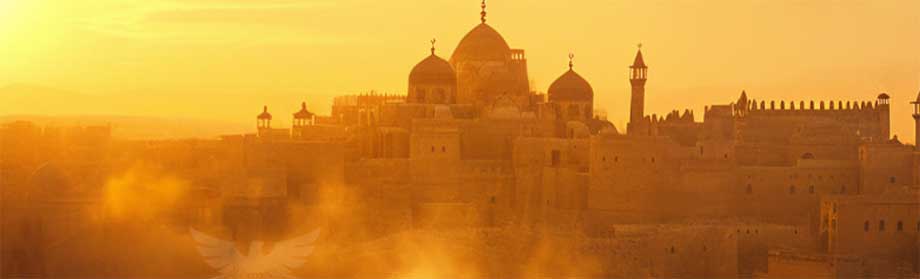
How realistic is the establishment of a caliphate, considering the overall geopolitical situation and the predicament of the ‘Muslim states’ in particular? The sad fact is that it seems virtually impossible at the moment! It would take nothing less than cataclysmic events to make the caliphate a reality. But those could happen quickly! If the conflicts in the Middle East really do escalate into a conflagration, it could even lead to World War III. After that, the cards would be completely reshuffled.
Of course, one could argue that even if it is currently impossible to establish a caliphate, this does not exempt us from making efforts in this direction. And that is correct! But what efforts exactly? What does the Prophet (peace and blessings of Allah be upon him) tell us we should do at this time?
Hudhaifah (may Allah be pleased with him) reported: People used to ask the Messenger of Allah (peace and blessings of Allah be upon him) about good things, but I used to ask him about bad things so that I would not be afflicted by them. So I said: O Messenger of Allah, we were living in ignorance and in a (very) bad atmosphere, then Allah brought us this good (i.e. Islam); will there be any evil after this good? He said: ‘Yes.’ I asked: "Will there be any good after this evil? He replied, ‘Yes, but it will be tainted (i.e. not pure).’ I asked, ‘What will be its taint?’ He replied, ‘There will be some people who will guide others, but not according to my guidance. You will approve of some of their deeds and disapprove of others.’ I asked, ‘Will there be anything bad after this good?’ He replied, ‘Yes, there will be people who will call others to the gates of Hell, into which they will throw those who obey them.’ I asked the Messenger of Allah to describe them to us, and he said, ‘They will be from our own people and will speak like us.’ I asked him what instruction he would give me if this happened in my time, and he replied, "You must adhere to the Jama'ah and the Imam (i.e., the Amir or leader of the Jama'ah, whose authority is established by the act of Baiy'ah). I asked: What if there is neither a Jama'ah nor an Imam? He said: Then turn away from all these firaq (different groups that have split off), even if you have to eat the roots of a tree until death overtakes you while you are in that state. (Bukhari und Muslim)
This hadith highlights a very important aspect: although it is generally obligatory to adhere to the Jama'ah and its Amir (the Caliph), this only applies as long as there is a Jama'ah and a Caliph, which has not been the case for a hundred years. It seems logical that we must now try to establish a new Caliphate. But the Prophet commands us to do the opposite: we should avoid all groups, even those that strive for the caliphate! And that makes sense, of course, when we see the current state of the Ummah. No matter which group we follow today, it will surely end in fitnah to present this group as the rightly guided one and expect all other Muslims to join it. That has not worked for a hundred years!
This is the time when one should retreat and seek safety from the storm. Muslims will not be able to unite and appoint a caliph at this time. Only after the cataclysmic events of the great war will Allah himself send a leader, the Mahdi. The proof for this can be found in the following hadith, among others:
Ummu Salamah (may Allah be pleased with her) reported that the Prophet (peace and blessings of Allah be upon him) said: "After the death of a ruler, there will be a dispute, and a man from the Bani Hashim will flee from Al-Madinah to Mecca. Some of the people of Mecca will come to him and bring him out against his will, and they will pledge allegiance to him between the corner [Black Stone] and the Maqam." (Sunan Abu Dawud, Musnad Ahmad)
These inhabitants swear allegiance to the Mahdi because there is no caliph yet and because they recognise the prophesied characteristics of the Mahdi.
From all of the above, we can draw the following conclusions:
- It is good to educate Muslims about the importance of the caliphate and Sharia law as the basis of an Islamic society, which will hopefully be counted as fulfilling the duty to strive to establish a caliphate.
- It is not a good idea to join a group that has made the establishment of the caliphate its mission. Firstly, because it will potentially involve you in fitnah; secondly, because it is a futile endeavour and takes time and energy that would be better spent elsewhere; and, of course, because the Prophet (peace and blessings of Allah be upon him) himself advised us against it. Instead, one should generally avoid groups and work towards the unity of Muslims. Da'wah for a caliphate supports unity, whereas joining or founding a group supports fragmentation.
- So it is better to prepare for what is currently approaching us at great speed, or rather, what has already begun: the Third World War and the tribulations of the end times! This means leaving the northern countries if possible, getting out of the cities if possible, and moving to remote areas in the south or to areas with special status such as Mecca, Medina, Syria, Yemen or Afghanistan.
And Allah knows best. May He always guide us and protect us from fitnah.
____________________
Related Articles:
 |
The wrong flag A flag is a piece of cloth, usually rectangular, of characteristic color and design, which is used as a symbol, signal or emblem. The flag stands for an idea. People should identify with this idea and thereby show solidarity and mobilize... |
 |
Seeking Hidaya Guidance is a central theme of the Qur'ân, it is mentioned far more than a hundred times therein! It is itself called "the guidance for the god-fearing" and "the criterion (of right and wrong)"! Unfortunately, Qur'ân and Sunnah are nowadays mostly reduced to its function as the "lawgiver" only, not so much seen as a spiritual guide... |